
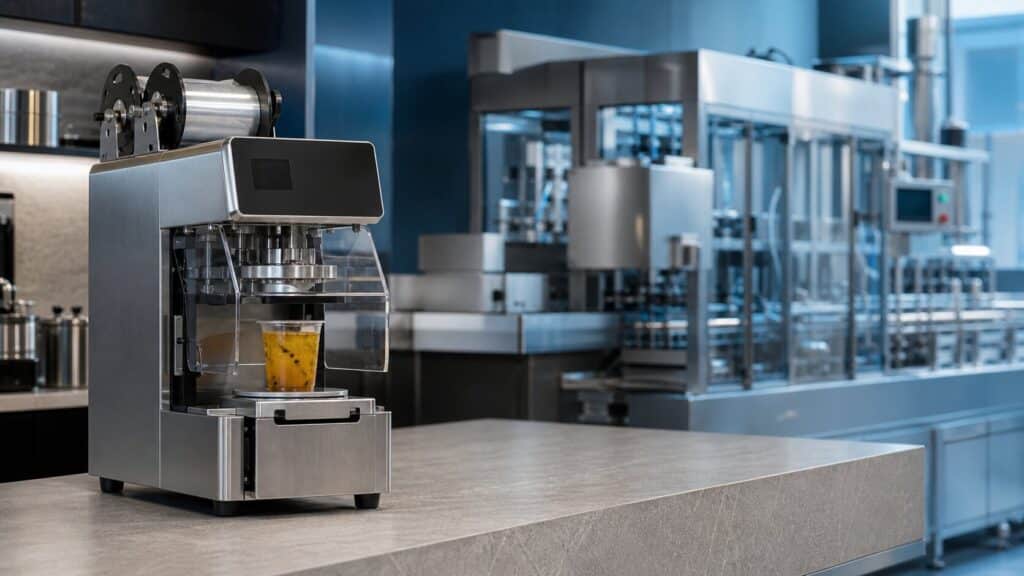
The short answer: the difference between desktop and industrial machines comes down to output scale and whether it integrates into a production line. A desktop machine is compact, stands alone on a counter or workbench, and suits outlets and small-to-mid output. An industrial machine has high output, often integrates filling and continuous conveying, and is designed for factory lines. Sizing is not “bigger is better” — match it to your daily/hourly output and whether you need filling. An industrial machine for low volume wastes money; a desktop machine for high volume becomes the line’s bottleneck.
The fundamental difference
Desktop sealing machine
- Role: standalone, counter or workbench operation, cups/boxes placed by hand.
- Output: measured in cups per minute or boxes per hour, for outlets and small-to-mid volume.
- Setup: plug in and go, small footprint, easy to move.
Industrial sealing machine
- Role: integrated into a line, often combining filling, conveying and continuous sealing.
- Output: built for continuous production, pairs with automatic filling.
- Setup: requires line space, workflow and power planning — an equipment investment.
Desktop vs industrial comparison
| Item | Desktop | Industrial |
|---|---|---|
| Use case | Outlets, counters, small-to-mid volume | Food factories, continuous lines |
| Operation | Manual placement, standalone | Automatic conveying, continuous |
| Filling integrated | Usually not | Often filling + sealing |
| Footprint & setup | Small, plug and go | Requires line planning |
| Investment scale | Single machine | Production-line investment |
How to decide which you need
- Calculate output first: how many cups or boxes per day/hour? Outlet-level → desktop; factory-level continuous production → consider industrial.
- Do you need filling? Sealing only → desktop is enough; continuous “fill + seal” → industrial.
- Space and labor: limited counter space, manual operation → desktop; line space and a goal to cut labor → industrial.
Applicable models
Desktop: for beverage cups, see the K-2590SA sealing machine (∮90/95mm, about 5–12 cups/min, 20kg net); for boxed food, the K-255X (sealing range ∮155mm, 400–500 boxes/hour, built-in auto box-lift).
Industrial: for continuous boxed (meal-box) production, the KV-4300-2 fully automatic filling-and-sealing machine (pneumatic filling plus a two-stage sealing technique, suited to water, soy milk, jelly and more); for slush-type beverage lines, the KV-3000-4 slush filling-and-sealing line. Actual line planning is best assessed by Kai Will against your needs.
FAQ
Q: Business grew and my desktop machine can’t keep up — now what?
First find whether the bottleneck is sealing speed or filling. If sealing simply can’t keep pace, evaluate a higher-output desktop machine or running several in parallel; only continuous fill + sealing warrants going industrial.
Q: Is industrial always better than desktop?
No. Industrial machines are built for continuous lines; if your volume never uses that, the cost and space become a burden. Size to your output and whether you need filling.
Q: Can I start with desktop and upgrade to industrial later?
Yes. Most outlets start with desktop and evaluate industrial once volume grows enough to need a continuous line. Share your growth plan with Kai Will so we can prepare an upgrade path.
Next step
Work out your daily/hourly output, confirm whether you need filling, then contact Kai Will — we’ll recommend a desktop or industrial solution for your scale.
Compiled by the Kai Will technical team. Content is updated on an ongoing basis; the official version is pending Kai Will confirmation.